
1. Executive Summary#
Since the introduction of Retrieval-Augmented Generation (RAG) by Lewis et al. (2020), the industry default for grounding LLMs has been naive vector similarity: slice PDFs into 500-token chunks, embed them into dense vectors, and dump the top-k cosine matches into the prompt. Meanwhile, the arrival of 1M+ token context windows prompted claims that "RAG is dead." Both viewpoints miss the realities of production systems.
Core Thesis: RAG is a runtime retrieval pattern for searching uncurated text, whereas the Open Knowledge Format (OKF) is a deterministic, graph-structured packaging standard for curated concepts. Pairing OKF with hybrid retrieval solves both RAG's semantic fragmentation and long-context degradation.
2. Why Naive Vector RAG Hits a Ceiling#
Classical vector RAG suffers from three architectural blind spots:
- Chunk Boundary Slicing: Arbitrary token splitters sever antecedents from pronouns, tables from headers, and caveats from policies. A chunk stating "This exception applies only to Tier-3 accounts" loses all meaning if the definition of Tier-3 was in the previous chunk.
- Cosine Similarity != Relevance: Dense embeddings compress semantics into a single point on a hypersphere. They excel at finding passages that sound similar to the query, but fail when answering a query requires multi-hop reasoning across distinct documents.
- Lack of Epistemic Hierarchy: In a flat vector index, an outdated Slack message from 2022 and an official 2026 architecture spec look identical if their embedding vectors align with the user's prompt.
3. Why 1M-Token Context Windows Haven't Killed Retrieval#
Even when an entire codebase or document corpus fits inside a 1M-token window, stuffing everything into the prompt fails in production for two reasons:
- Attention Dilution ("Lost in the Middle"): As context grows past 100k tokens, softmax attention weights disperse across thousands of distracting tokens, degrading multi-step reasoning accuracy even when simple "needle-in-a-haystack" retrieval succeeds.
- TTFT & Unit Economics: Without a 100% cache hit, prefilling 500k tokens per user query requires massive compute, driving latency to 15+ seconds and multiplying API costs by 50x compared to targeted retrieval.
4. Enter OKF (Open Knowledge Format)#
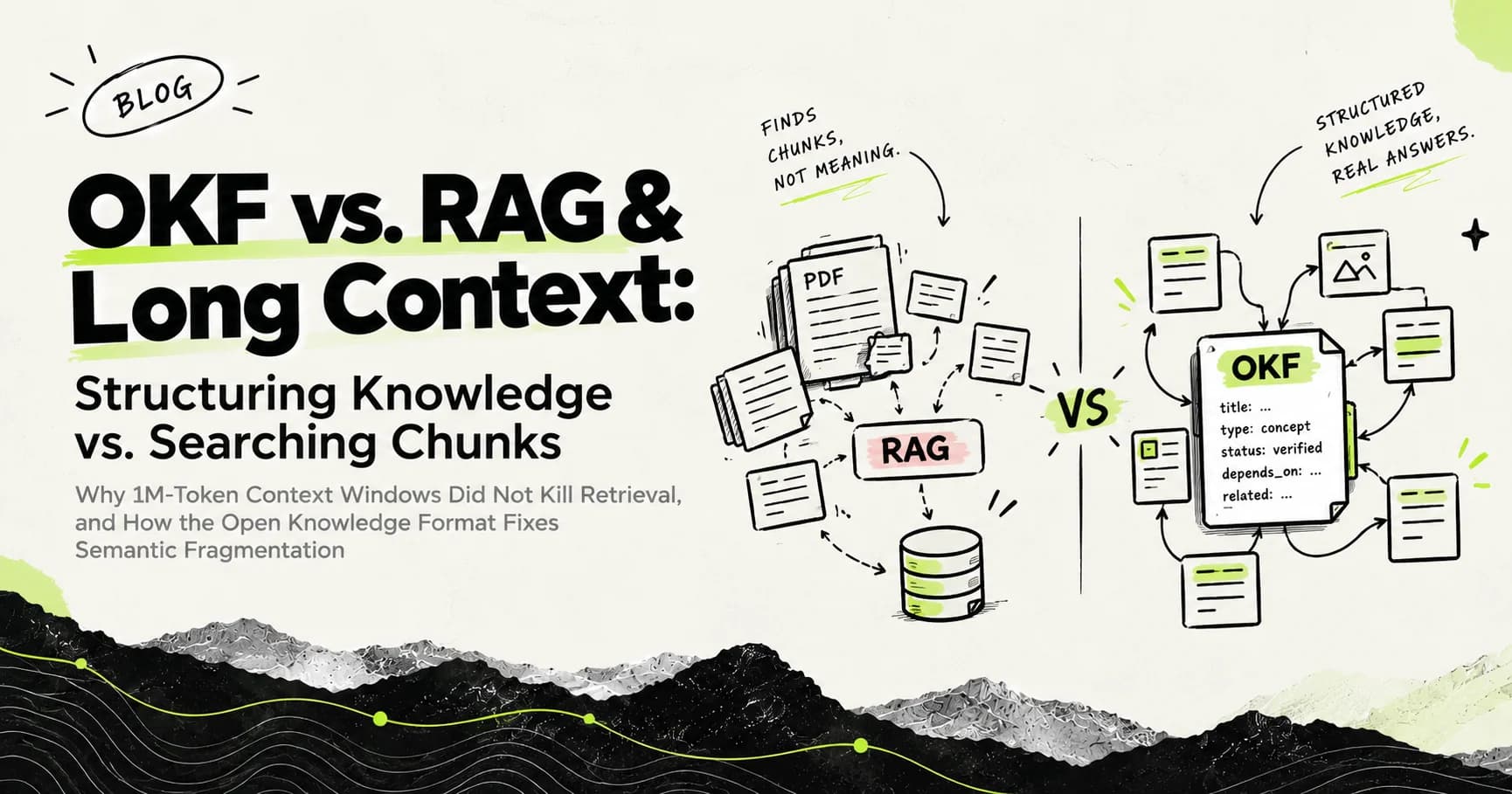
Instead of treating enterprise knowledge as opaque vector blobs, the Open Knowledge Format structures domain knowledge as a version-controlled, human- and agent-readable knowledge graph built on Markdown files with typed YAML frontmatter.
Core Pillars of OKF:#
- Atomic Concept Nodes: Each file represents one self-contained concept, API contract, or business rule rather than an arbitrary 512-token slice.
- Explicit Typed Edges: YAML frontmatter declares deterministic relationships (
depends_on,supersedes,related_concepts,owner,status: verified). - Deterministic Agent Traversal: Instead of guessing via vector similarity alone, an agent lands on an entry node (via hybrid search or routing index) and traverses explicit links to gather complete, unfragmented context windows.
5. Pipeline Comparison#
- Classical RAG Pipeline:
Unstructured Docs -> Fixed-Size Chunker -> Embedding Model -> Vector DB -> Top-K Chunks -> Prompt - Modern Hybrid OKF + RAG Architecture:
Curated Markdown + YAML Graph (OKF) -> Hybrid Index (BM25 Lexical + Dense Vector + Graph Edges) -> Cross-Encoder Reranker -> Sub-Graph Context Assembly -> Prompt
6. When to Use Which#
- Use Classical Hybrid RAG (BM25 + Vectors + Reranker): Over massive, high-volume, unstructured archives (support tickets, call transcripts, legal discovery dumps, raw logs).
- Use OKF (Curated Knowledge Graph): For core product documentation, engineering runbooks, API specifications, compliance rules, and agent skills where precision and zero hallucination are mandatory.