
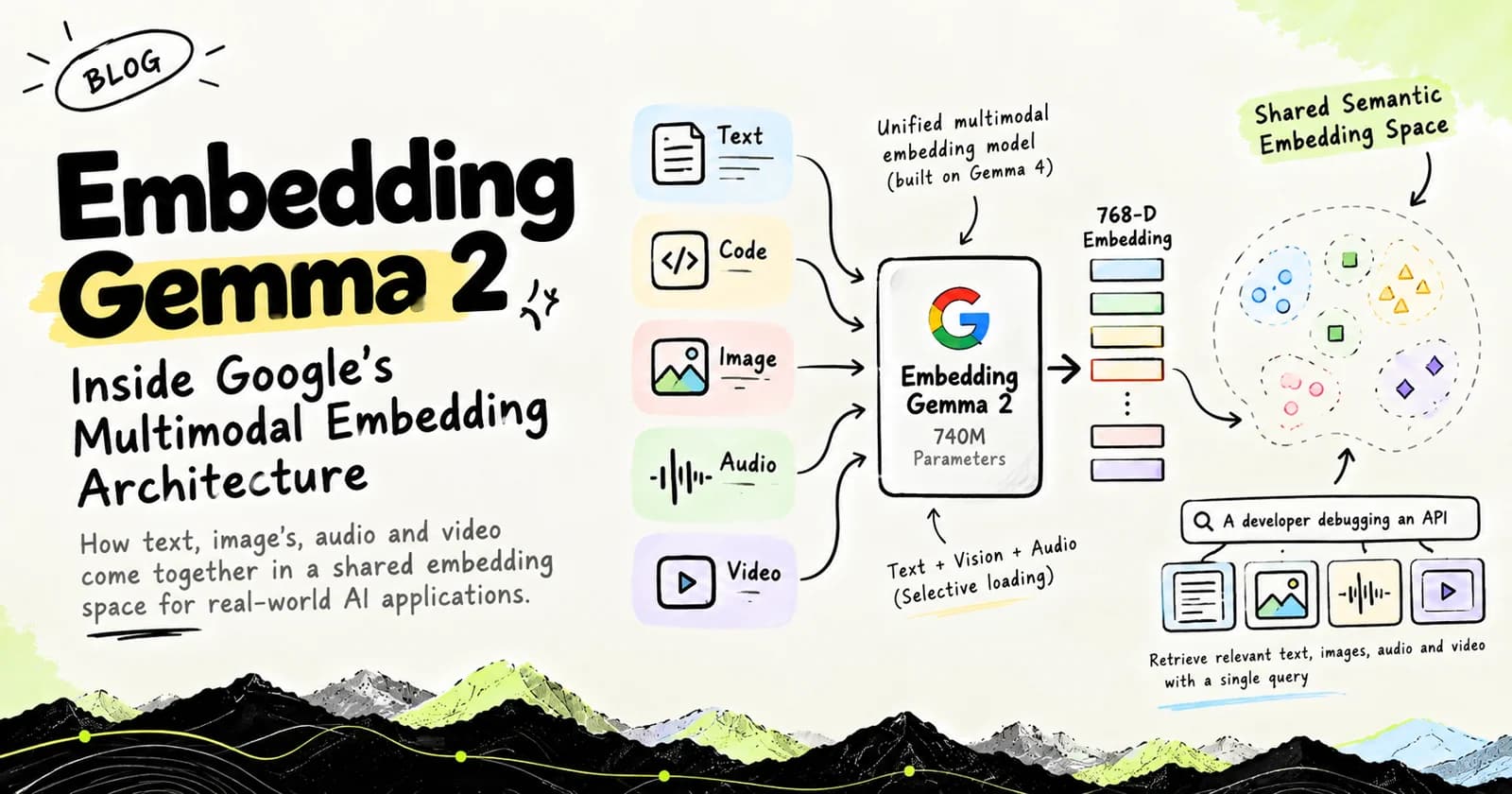
What if a single search system could retrieve relevant information from documents, source code, screenshots, audio recordings, and videos without treating every modality as an isolated data source?
Google's EmbeddingGemma 2 explores this direction by mapping different types of content into a shared semantic embedding space.
For AI engineers building RAG pipelines, knowledge assistants, and multimodal search systems, the interesting part is not simply generating vectors. It is understanding how these representations are produced, aligned, and used for retrieval.
Let's look under the hood.
01. The Problem: Different Modalities, Different Embedding Spaces#
Traditional retrieval systems often use separate models for text, images, and audio. Each model learns its own representation space, which makes direct cross-modal comparison difficult.
Consider a knowledge base containing:
- Documentation describing a software deployment.
- A screenshot of the deployment dashboard.
- A recording discussing the deployment failure.
- A video demonstrating the debugging process.
A text embedding model can retrieve relevant documentation, but searching all these sources requires representations that are compatible across modalities.
Having the same vector dimensions does not guarantee that two embedding spaces are compatible.
EmbeddingGemma 2 addresses this challenge by producing representations designed for cross-modal semantic retrieval.
02. Architecture Under the Hood#
EmbeddingGemma 2 is built on Google's Gemma 4 architecture. Its full multimodal configuration contains approximately 740 million parameters, including a text backbone, an embedding component, and dedicated vision and audio encoders.
The model's documented configurations allow applications to load only the modalities they require.
At a high level, the pipeline looks like this:
         TEXT        IMAGE        AUDIO
           |            |            |
           v            v            v
      Tokenizer     Vision         Audio
                    Encoder        Encoder
           |            |            |
           +------------+------------+
                        |
                        v
               Contextual Processing
                        |
                        v
                  Mean Pooling
                        |
                        v
                  512 → 768
                    Projection
                        |
                        v
                  Normalization
                        |
                        v
                 768-D Embedding
This is a conceptual representation of the embedding pipeline, not the model's complete internal computation graph. Video is processed through sampled frames using the vision pathway.
The transformer contextualizes input representations, allowing the model to capture relationships between concepts rather than relying exclusively on individual words or visual features.
The resulting representation is converted into a fixed-size vector suitable for semantic comparison.
03. How Multimodal Alignment Works#
The central challenge is making representations from different modalities semantically comparable.
Suppose a system receives:
- Text: "A developer debugging an API."
- Image: A screenshot of API logs.
- Audio: A discussion about an API failure.
- Video: A recording of someone debugging the application.
A multimodal model can represent these inputs within a shared embedding space.
Conceptually:
[ E_t(x), E_i(x), E_a(x), E_v(x)\in\mathbb{R}^{768} ]
The representations are designed to support meaningful comparisons across modalities.
One useful way to understand multimodal training is through contrastive learning. Models trained with contrastive objectives learn to associate corresponding examples and distinguish them from unrelated content.
The precise training recipe should not be inferred from this general explanation alone, but the principle illustrates why cross-modal alignment matters.
Once the representations are compatible, a text query can retrieve relevant images, audio recordings, or video segments using vector similarity.
This enables retrieval without requiring every image or recording to be converted into a textual caption first.
04. From Embeddings to a Production RAG Pipeline#
EmbeddingGemma 2 is a retrieval component, not a complete RAG system.
A practical architecture still needs ingestion, storage, indexing, retrieval, and answer generation.
       DOCUMENTS / IMAGES / MEDIA
                   |
                   v
             Preprocessing
                   |
                   v
             Embedding Model
                   |
                   v
             Vector Database
                   |
                   v
               User Query
                   |
                   v
             Query Embedding
                   |
                   v
              Vector Search
                   |
                   v
            Relevant Candidates
                   |
                   v
          Context + Generative LLM
                   |
                   v
               Final Answer
For a production implementation, I would separate vector storage from metadata storage.
The vector database handles similarity search, while metadata preserves source identifiers, timestamps, access permissions, and references to the original content.
For long recordings, segment-level embeddings are particularly useful. Instead of embedding an entire meeting as one vector, the system can index smaller segments and return the relevant timestamp.
This improves retrieval granularity and makes the original evidence easier to inspect.
05. Reducing Storage with Matryoshka Embeddings#
EmbeddingGemma 2 supports Matryoshka Representation Learning, which allows useful representations at different embedding dimensions.
Its default output is 768-dimensional, with shorter representations available for supported configurations.
Reducing dimensionality can substantially lower vector storage requirements.
For example, storing 10 million vectors as 32-bit floating-point values requires approximately:
| Dimensions | Raw vector storage |
|---|---|
| 768 | 30.72 GB |
| 512 | 20.48 GB |
| 256 | 10.24 GB |
These figures exclude database indexes and metadata.
Smaller vectors can reduce storage and retrieval costs, but they may also reduce retrieval quality. The correct choice depends on the application and should be validated against a representative evaluation dataset.
For production systems, I would start with 768 dimensions, benchmark smaller configurations, and select the smallest representation that meets the required quality threshold.
06. Practical Engineering Considerations#
Before deploying a multimodal embedding system, several details deserve attention.
Segmentation: Long documents and recordings should be divided into meaningful units when fine-grained retrieval matters.
Task-specific prompts: Query and document embeddings may require different instructions. Following the model's recommended prompting conventions is important for retrieval quality.
Evaluation: Measure retrieval quality using metrics such as Recall@k, mean reciprocal rank, and nDCG rather than relying on a few successful examples.
Latency and memory: Model configuration, quantization, batch size, and media preprocessing all affect resource consumption.
Grounding: Semantic similarity does not establish factual correctness. Retrieved content should be evaluated and supplied as evidence when generating answers.
These considerations often determine whether a promising embedding model becomes a useful production component.
Conclusion#
EmbeddingGemma 2 demonstrates how a relatively compact model can support semantic retrieval across multiple modalities through shared embedding representations.
Its architecture, configurable modality support, and dimensionality reduction capabilities make it an interesting option for building multimodal knowledge systems.
For AI engineers, the broader lesson is that effective retrieval requires more than converting data into vectors. It requires compatible representations, careful indexing, measurable retrieval quality, and an architecture that connects retrieved evidence to the final application.
The real opportunity is to make information searchable by meaning, regardless of whether it originated in a document, a screenshot, an audio recording, or a video.
References#
- Google's EmbeddingGemma 2 announcement.
- EmbeddingGemma 2 technical model card.
- Google's Sentence Transformers implementation guide.