
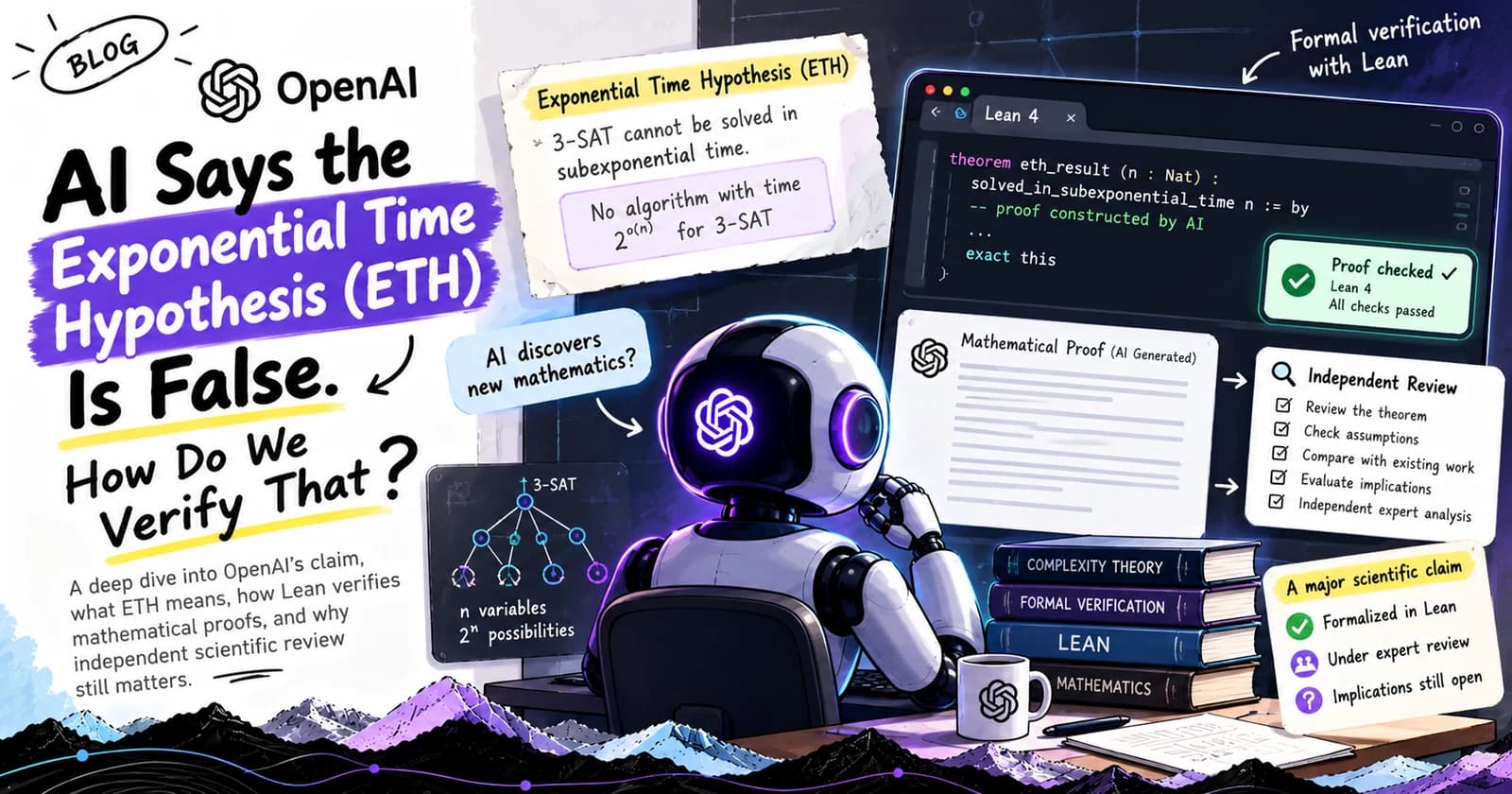
Introduction: What Happens When AI Challenges a Foundational Scientific Assumption?#
Imagine an AI system announcing that a conjecture used by theoretical computer scientists for decades is false.
The claim is not a minor improvement to an existing algorithm. It challenges an assumption that researchers have used to establish conditional computational lower bounds across numerous areas of computer science.
Would you immediately accept the result?
Probably not. But dismissing it simply because an AI system produced it would be equally premature.
The right response is to examine the evidence.
On October 26, 2026, OpenAI announced several AI-generated research results spanning mathematics, theoretical computer science, and mathematical physics. One of the most striking claims was a proposed refutation of the Exponential Time Hypothesis (ETH), a longstanding conjecture concerning the computational difficulty of Boolean satisfiability problems.
OpenAI reported that its system produced the mathematical argument and that the result was subsequently formalized in Lean, a proof assistant used to check mathematical proofs. The company also announced a collaboration with computer scientists who will examine and explain the result.
This creates an important distinction.
An AI system can generate a mathematical argument. A formal proof assistant can check a precisely encoded theorem and its proof. Independent researchers must still examine what the theorem means, whether it matches the original claim, and what the result implies for the field.
These are related, but different, responsibilities.
For AI engineers, mathematicians, and researchers building AI-powered scientific tools, this story raises a broader question:
How do we turn an AI-generated discovery into a result that other people can independently verify and trust?
To answer that, we need to understand the hypothesis, formal verification, Lean, and the role of independent scientific review.
1. What Is the Exponential Time Hypothesis?#
The Exponential Time Hypothesis, usually abbreviated as ETH, is a conjecture in computational complexity theory.
To understand why its proposed refutation matters, it helps to start with a fundamental computer science problem: Boolean satisfiability.
A quick introduction to SAT#
A Boolean formula is built from variables that can be either true or false, combined using logical operators.
For example:
(A OR B) AND (NOT A OR C)
The satisfiability problem asks whether there is an assignment of true and false values to the variables that makes the entire formula true.
This is known as SAT.
SAT is a foundational problem in theoretical computer science. The broader problem of determining whether Boolean formulas can be satisfied is central to the study of computational complexity.
The difficulty increases as the number of variables and constraints grows. For general SAT instances, no polynomial-time algorithm is known, and the problem is NP-complete.
What does ETH claim?#
Informally, ETH asserts that 3-SAT cannot be solved in subexponential time in the number of variables, under its standard formulation.
A subexponential running time grows more slowly than (2^{cn}) for every fixed positive constant (c), in the relevant asymptotic sense.
Why does this matter?
Complexity theorists use assumptions such as ETH to derive conditional lower bounds. These results help researchers understand how efficiently particular problems can be solved, assuming the hypothesis holds.
ETH has been used in research involving graph algorithms, computational geometry, databases, computational biology, and other areas. OpenAI's announcement describes it as a widely used assumption in theoretical computer science.
Why would refuting ETH be significant?#
If a valid result establishes that the relevant satisfiability problem can be solved in subexponential time, it would challenge the standard ETH conjecture.
That could require researchers to revisit conditional lower bounds that depend on the hypothesis.
However, a theoretical algorithm does not automatically translate into a practical speedup for ordinary software.
There are two different questions:
- Does the mathematical result establish the claimed complexity bound?
- Can researchers turn that result into algorithms that improve practical performance?
Even if the first question is answered positively, the second may require substantial additional research.
That distinction matters when interpreting claims about breakthroughs in theoretical computer science.
2. What Exactly Did OpenAI Claim?#
OpenAI's October 26 announcement described three research results in mathematics, theoretical computer science, and mathematical physics.
For this article, the central result is the proposed refutation of ETH.
According to OpenAI, its system produced a natural-language disproof on October 16, 2026. The company says the result was formalized in Lean the following day. The announcement also states that an independent working group led by Russell Impagliazzo, Ramamohan Paturi, and Ryan Williams will examine and explain the result.
The accompanying research materials describe a deterministic algorithm for exactly counting satisfying assignments of fixed-width Boolean formulas in subexponential time and polynomial space. The 3-SAT case is presented as the refutation of ETH.
These details make the claim concrete enough to investigate.
But there is an important editorial distinction between three statements:
- OpenAI announced that its AI system produced a mathematical result.
- OpenAI reported that the result was formalized and checked in Lean.
- The wider research community has independently assessed the result and established its implications.
The first two statements describe what OpenAI has reported. They should not automatically be treated as proof that every scientific implication of the third statement has been settled.
This is not an argument against AI-generated research. It is a reason to make the verification process visible.
The more consequential a scientific claim is, the more important it becomes to examine the actual mathematical statement, the supporting evidence, and the independent review process.
3. Why an AI-Generated Mathematical Explanation Is Not Enough#
Modern AI systems can produce mathematical explanations that appear detailed, coherent, and convincing.
They can introduce definitions, manipulate equations, outline algorithms, and present long chains of reasoning.
But a convincing explanation is not necessarily a correct proof.
A mathematical argument can fail in several ways:
- A step may not follow logically from the previous one.
- An assumption may be used without being stated.
- A definition may differ from the standard meaning of the term.
- A proof may establish a weaker result than the headline suggests.
- A theorem may be technically correct but fail to address the intended research question.
These problems are not unique to AI. Human-written mathematical proofs also require scrutiny.
The difference is that AI systems can generate large volumes of technical material quickly. That makes it especially important to have efficient ways to check the output.
Imagine receiving a 100-page mathematical manuscript from an AI system.
Reading it carefully might take days or weeks. Reconstructing every derivation could take even longer.
A formal proof offers another route: express the theorem and its supporting reasoning in a precise language that a proof assistant can check.
Instead of relying exclusively on the quality of the explanation, researchers can examine a formal artifact.
This does not eliminate the need for human judgment. It changes which parts of the argument can be checked mechanically and which questions still require interpretation.
4. What Is Lean, and How Does It Verify a Proof?#
Lean is a programming language and interactive theorem prover designed for formal mathematics and software verification.
It allows mathematical statements, definitions, and proofs to be represented in a formal language.
A proof assistant can then check whether the proof establishes the encoded theorem from the definitions, assumptions, and axioms available in the environment.
Lean's architecture includes a small kernel responsible for checking proof terms. Tactics and other automation can help construct proofs, but the resulting proof terms are checked by the kernel.
This is a powerful approach because it separates generating a proof from checking it.
An AI system might spend a great deal of computation searching for a proof. A formal checker can then validate the resulting artifact according to the rules of the formal system.
A simplified example#
Consider the mathematical statement:
If (a=b), then (b=a).
In ordinary mathematical notation, the result follows from the symmetry of equality.
A simplified Lean theorem looks like this:
theorem equality_is_symmetric (a b : Nat) (h : a = b) : b = a := by
  exact h.symm
This example uses Lean's equality symmetry rule to prove a simple statement about natural numbers.
The code is intentionally small. Its purpose is to illustrate the structure of a formal theorem, not to reproduce the much more complicated ETH result.
A large theoretical computer science result would require formal definitions of the relevant objects, a precise statement of the complexity bound, and a proof that the constructed algorithm satisfies that bound.
The proof assistant checks the formal argument within the environment provided.
What does a successful Lean check mean?#
A successful check provides evidence that the encoded proof follows from the formal definitions, declarations, and axioms used by the proof.
That is a meaningful guarantee.
It is much stronger than asking an AI model whether its own answer is correct.
However, the checker does not independently determine whether the formal theorem captures the intended scientific claim.
That distinction is central to understanding AI-generated mathematical discoveries.
5. What a Formal Proof Does Not Automatically Establish#
A machine-checked proof is an important verification milestone, but it does not answer every question researchers may have about a result.
Consider five separate questions.
| Question | What is needed? |
|---|---|
| Is the encoded proof valid? | Formal proof checking |
| Does the theorem state the intended result? | Mathematical and domain-specific review |
| Are the definitions and assumptions appropriate? | Inspection of the formalization and its context |
| Is the result genuinely new? | Comparison with existing literature |
| What are the implications for the field? | Independent expert interpretation |
These questions overlap, but they are not interchangeable.
The theorem statement matters#
Suppose an AI system proves a theorem that looks related to a famous conjecture.
The proof might be completely valid, but the formal statement could differ from the original conjecture in a crucial way.
Perhaps a condition is missing. Perhaps the variables have been restricted. Perhaps the definitions do not match the standard formulation.
The proof assistant cannot infer the researcher's intended meaning unless that meaning is correctly represented in the formal statement.
Lean's documentation explicitly distinguishes checking whether a theorem has a valid proof from understanding what the theorem statement means.
Formal correctness and scientific significance are different#
Even if a formal theorem is correct, researchers must determine how it relates to prior work.
A result might be a special case of an existing theorem. It might depend on a known assumption. It might be mathematically valid but less consequential than its public description suggests.
Alternatively, it could represent a genuinely important advance.
The point is that formal correctness is one part of scientific evaluation, not a replacement for the entire process.
A proof checker can validate a formal derivation. Researchers must still establish what that derivation means.
6. How Should Researchers Verify a Major AI-Generated Claim?#
A reliable verification process should make it possible for independent researchers to examine the evidence without relying on the original model's explanation or the institution that produced it.
For a claim as consequential as a proposed refutation of ETH, I would approach the process in stages.
Step 1: Read the precise theorem statement#
Start with the mathematical claim itself.
Do not rely only on a press release, a social media post, or a simplified explanation.
Identify exactly what the theorem asserts, including its conditions, definitions, and complexity bounds.
For ETH, the important questions include which satisfiability problem is considered, what parameters the running time depends on, and whether the claimed bound is genuinely subexponential in the relevant number of variables.
Step 2: Inspect the definitions and assumptions#
Determine whether the formal definitions match the concepts used in the original conjecture.
Check which assumptions are required and whether the proof relies on any additional conditions.
This step helps identify situations where a proof is valid but does not establish the claim readers think it establishes.
Step 3: Check the formal proof artifact#
Inspect the Lean formalization and confirm that the proof checker accepts the theorem.
Researchers should understand the formal environment, imported definitions, and axioms used by the proof.
The goal is to establish exactly what has been checked, rather than relying on a statement that the work has been formalized.
Step 4: Connect the formal result to the mathematical argument#
A formal artifact and a natural-language manuscript serve different purposes.
The formal artifact allows mechanical checking. The written argument helps researchers understand the construction, assumptions, proof strategy, and significance.
The two should be compared carefully.
Researchers need to determine whether the formalized result corresponds to the central claim of the manuscript, rather than merely proving an auxiliary statement.
Step 5: Compare the result with existing literature#
A correct theorem may still require context.
Researchers should examine earlier results, equivalent formulations, known algorithms, and related conjectures.
For a proposed refutation of ETH, this is especially important because the hypothesis has influenced many conditional complexity results.
Step 6: Invite independent expert review#
Independent researchers can challenge the assumptions, examine the argument, identify missing context, and assess the result's implications.
OpenAI's announced collaboration with Russell Impagliazzo, Ramamohan Paturi, and Ryan Williams is relevant here because the group is tasked with examining and explaining the ETH result. OpenAI also said it agreed to make the raw research materials publicly available to support broader examination.
Public access is valuable because it allows scrutiny beyond the original research team.
The process should remain open to corrections, alternative interpretations, and revisions as researchers investigate the claim.
Step 7: Communicate the level of confidence accurately#
The final step is often overlooked.
When writing about an AI-generated result, separate what has been announced, what has been formally checked, and what has been independently established.
A useful report should identify unresolved questions rather than treating uncertainty as an inconvenience.
That approach makes the research more credible, not less.
7. A Practical Experiment: Build a Miniature AI Proof-Verification Pipeline#
You do not need to solve a famous mathematical conjecture to understand how AI-generated proofs can be checked.
A small experiment can demonstrate the basic workflow.
The objective is to build a system in which an AI proposes a simple mathematical claim, generates a formalization, and attempts to have Lean verify it.
The experiment should include both a valid claim and a deliberately incorrect one.
The workflow#
1. Ask an AI system to propose a simple theorem.
For example:
"If a natural number is even, then its square is even. Provide a Lean 4 formalization and explain the proof."
2. Save the theorem and proof to a Lean project.
Use a local development environment so that you can inspect the source and reproduce the result.
3. Run the Lean checker.
Record whether the formalization compiles and whether the theorem is accepted.
A successful check is evidence about the formal theorem in that environment. It is not a general endorsement of every statement in the AI's explanation.
4. Introduce a deliberately false claim.
For example:
"Every natural number is even."
Ask the AI to formalize the statement and attempt a proof.
The system should fail to establish the claim unless the formal environment has been changed in a way that affects its meaning or soundness.
5. Inspect the failure.
Record whether the model produced an invalid proof, used an inappropriate assumption, or generated code that did not compile.
A failed attempt is useful experimental evidence. It shows where the workflow needs to detect and report errors.
6. Keep the artifacts.
Save the prompt, generated source code, Lean version, dependencies, checker output, and any revisions.
This makes the experiment reproducible and helps distinguish successful verification from an informal explanation that merely sounds correct.
What should you measure?#
For a small experiment, track the following:
- Whether the generated code compiles.
- Whether Lean accepts the proof.
- Whether the theorem matches the intended claim.
- How many attempts were needed.
- Whether the model introduced unnecessary assumptions.
- Whether a human had to correct the formalization.
- Whether another person can reproduce the result.
This experiment does not establish anything about the validity of OpenAI's ETH claim. It demonstrates the basic verification pattern on manageable examples.
The important principle is to test the entire process, including how it handles failure.
8. Why This Matters Beyond Mathematics#
The broader lesson applies to nearly every area where AI systems generate outputs that need to be trusted.
An AI system should not simply produce a plausible answer. Where possible, it should provide evidence that the answer satisfies the relevant constraints.
This is already a familiar principle in software engineering.
AI-generated code#
An AI coding assistant can generate a function that looks correct.
But developers still need tests, type checks, static analysis, and code review.
A successful test suite does not prove that a program is free from every defect. It does provide evidence about the behavior covered by those tests.
AI-generated database changes#
An agent may generate a database migration that appears reasonable.
Before deployment, the system can validate the schema, test the migration against representative data, and verify that the resulting database state matches expectations.
The agent's description of its work is not a substitute for checking the actual result.
AI-generated research summaries#
An AI system may summarize a paper and present several scientific claims.
Researchers can inspect the cited sources, compare the summary with the original findings, and distinguish established results from speculation.
A fluent summary should not be treated as primary evidence.
AI-generated mathematical proofs#
A mathematical agent can produce a proposed proof and, where practical, a formalization that a proof assistant can check.
Researchers can then investigate the theorem statement, definitions, assumptions, novelty, and implications.
Across these examples, the same pattern appears:
Generate a result, check it against explicit constraints, preserve the evidence, and make the outcome independently inspectable.
This is a useful design principle for AI systems that operate in high-stakes or technically demanding environments.
9. What AI Engineers Can Learn from This Development#
For developers building AI products, the ETH story offers several practical lessons.
Design for verification from the beginning#
Do not treat verification as a feature that can be added after an AI system starts producing outputs.
If a task requires a mathematical proof, plan for formal checking where practical.
If a task requires code, define the tests and validation procedures before asking the model to implement it.
If a task requires a research summary, decide how sources will be checked and how uncertainty will be represented.
The verification method should follow from the task.
Separate generation from evaluation#
The system that generates a result should not be the only mechanism responsible for declaring it correct.
An AI model can propose a solution. A separate checker, test suite, or validation process can evaluate it.
This does not mean every system needs another AI model. Deterministic tools are often better suited to checking precise conditions.
For formal mathematics, a proof assistant can check the encoded derivation. For software, tests and static analysis can check defined properties.
Preserve a verification trail#
Store the artifacts needed to reproduce the result.
Depending on the task, these may include:
- The original problem statement.
- The model-generated output.
- Formal proof files or source code.
- Tool and dependency versions.
- Checker or test results.
- Relevant assumptions.
- Human corrections and review notes.
A verification trail helps developers debug failures, compare system versions, and investigate disputed results.
Report uncertainty honestly#
AI products should distinguish between a proposed answer and a verified outcome.
For example, an application should not report that a proof has been verified when the formalization failed to compile.
It should not claim that a research finding is independently confirmed simply because the original authors published a formal artifact.
The product's language should reflect the evidence available.
These practices make AI systems easier to evaluate, maintain, and trust.
10. The Bigger Question: How Should Science Adapt to AI-Generated Discoveries?#
The ability to generate research material quickly creates opportunities as well as challenges.
AI systems may help researchers explore more candidate proofs, investigate unfamiliar mathematical structures, and develop ideas that would otherwise take significant time to discover.
But generating research artifacts faster does not automatically make them easier to understand or validate.
If AI systems produce more manuscripts than researchers can reasonably examine, the bottleneck may shift from discovery to verification.
That creates practical questions for the scientific community:
- How should AI-generated work be attributed?
- What information should accompany a proposed discovery?
- Which formal artifacts should be published?
- How can researchers reproduce the results?
- How should corrections and withdrawals be handled?
- What resources are needed for independent verification?
OpenAI's October 2026 announcement explicitly raises questions about verification, access, credit, and the future of research. Its proposed approach includes releasing materials and working with external researchers to examine the findings.
The long-term value of AI-assisted research will depend on more than the number of problems an AI system appears to solve.
It will also depend on whether researchers can understand the results, check the evidence, build on the work, and identify mistakes when they occur.
That is why formal verification and independent review deserve attention alongside improvements in model capability.
Conclusion: A Mathematical Claim Becomes Knowledge Through Verification#
OpenAI's proposed refutation of the Exponential Time Hypothesis is a compelling example of the questions raised by AI-generated research.
The company reports that its system produced a mathematical argument, that the result was formalized in Lean, and that a group of computer scientists will examine and explain the work.
These are meaningful steps in a verification process.
But they should not be collapsed into a single claim that every scientific implication has already been settled.
Lean can check a formal proof against its encoded definitions and assumptions. Researchers must still determine whether the formal statement captures the intended conjecture, how the result relates to existing work, and what it means for theoretical computer science.
For AI engineers, the lesson extends beyond mathematics.
A dependable AI system should produce more than an answer. Where possible, it should provide a way to check that answer, preserve the evidence, and communicate what remains uncertain.
As AI systems take on more demanding research and engineering tasks, this distinction will become increasingly important.
The future of AI-assisted discovery will depend not only on what models can generate, but also on how effectively humans and verification tools can establish what is actually true.
Official References and Further Reading#
-
OpenAI: Working with Academic Communities to Build Scientific Understanding
The announcement describing the proposed ETH refutation, the Lean formalization, and the independent research collaboration.
OpenAI research announcement -
Lean Language Reference
Technical documentation describing Lean's formal language and proof-checking architecture.
Lean Language Reference -
Lean Documentation: Validating a Proof
An explanation of what Lean's proof checker establishes and why the meaning of the theorem statement matters.
Validating a Lean Proof -
OpenAI: Sharing AI Progress in Mathematics
Background on OpenAI's approach to publishing AI-generated mathematical results and formalizations.
OpenAI mathematics research release
About the author
Sameer Bagul is an AI Engineer, Full-Stack Developer, and AI Product Builder interested in AI engineering, agentic systems, software development, and the practical methods required to turn emerging technology into useful products.