
Introduction: Moving from Passive Generative Video to Interactive World Models#
Over the last two years, generative visual AI has achieved photorealistic synthesis through diffusion and autoregressive video architectures like Sora, Runway Gen-3, and Google Veo. Yet despite their visual fidelity, these systems suffer from a foundational limitation: they are passive movie generators. You provide a prompt, wait twenty seconds, and receive an MP4 file. You cannot step inside the scene, press an arrow key to turn left around a building, inspect what lies behind a locked door, or converse with an in-scene character whose voice echoes dynamically off stone walls.
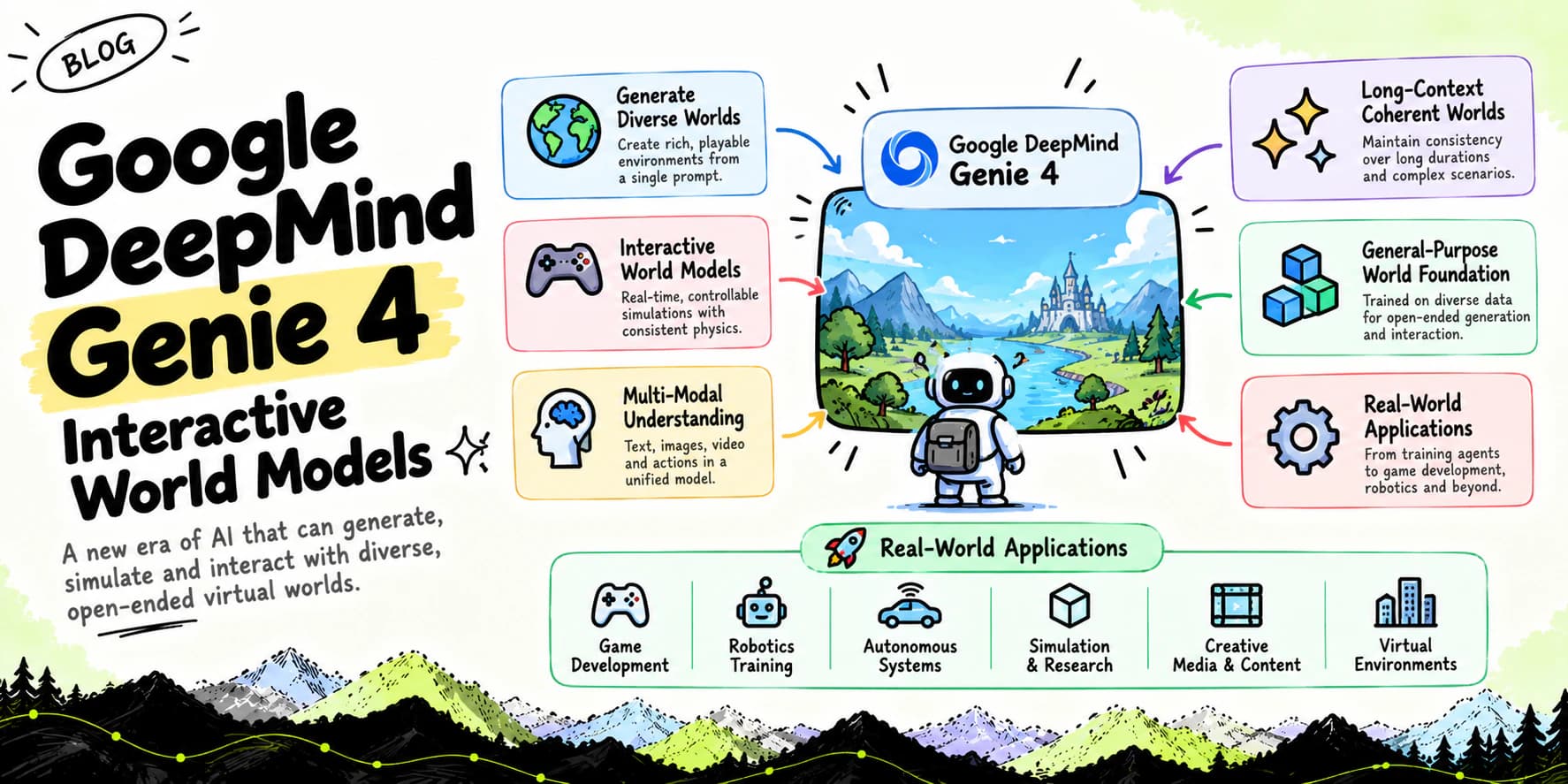
On October 27, 2026, Google DeepMind announced Genie 4, marking a critical transition from passive video synthesis to interactive, action-controllable world simulation.
Unlike its predecessor research prototypes, Genie 4 is an end-to-end interactive world model capable of generating real-time visual scenes, physical interactions, and—for the first time in the Genie lineage—native synchronized audio and interactive dialogue. Users and autonomous agents can steer the world simultaneously through continuous keyboard/controller inputs and real-time natural language prompts, while a co-steering cognitive engine powered by Gemini 3.8 Flash enforces narrative continuity and object permanence behind the scenes.
For software engineers, robotics researchers, and autonomous agent builders, Genie 4 represents a profound paradigm shift: generative AI is evolving into a programmable digital sandbox for testing robotic policies, validating agent workflows, and prototyping virtual experiences.
What Is a Generative World Model? Dynamics, Actions, and Latent Space#
To evaluate Genie 4, one must distinguish a world model from a standard text-to-video diffusion pipeline:
$$ ext{Video Diffusion: } p(V mid T) quad ext{where } V = [f_1, f_2, dots, f_k]$$ A video model predicts a static trajectory of frames $V$ conditioned on a static text prompt $T$. It has no concept of an internal agent taking actions.
$$ ext{Interactive World Model: } p(s_{t+1}, o_{t+1} mid s_{1:t}, a_t, c_t)$$ A world model maintains an evolving latent representation of the environment state $s_t$. At every discrete time step $t$, an agent or user issues an action $a_t in mathcal{A}$ (e.g., move forward, rotate camera pitch, jump) alongside continuous context conditioning $c_t$ (natural language instructions). The model predicts the next environment state $s_{t+1}$ and synthesizes the next observable visual and auditory frame $o_{t+1}$.
The Core Capabilities of Genie 4#
- Closed-Loop Action-Conditioning: Visual updates are not random hallucinated continuations; they are causally bound to user controls. Moving a joystick left causes camera parallax and terrain rotation matching physical expectations.
- Real-Time Dual-Channel Steering: Users can navigate the camera using standard controls while typing prompts like "Replace the desert path with a bioluminescent river and add rolling thunder." The environment transitions smoothly without dropping the player's spatial coordinates.
- Native Multimodal Audio Generation: Previous world models generated silent visuals requiring external sound models. Genie 4 synthesizes synchronized acoustic streams natively: the audio engine dynamically calculates reverberation, footstep sound effects on differing terrain surfaces, and spatial stereo panning as the camera rotates.
Latent Tokenization: Spatial-Temporal VQ-VAE Mechanics#
How does Genie 4 generate high-resolution video frames at interactive frame rates without prohibitive computational bottlenecks? The system relies on a Spatial-Temporal Vector-Quantized Variational Autoencoder (ST-VQ-VAE).
Rather than predicting raw RGB pixels across $1280 imes 720 imes 3$ colour values, the encoder compresses raw visual frames into a discrete 3D latent token grid: $$z_t = ext{Encoder}(x_{t - Delta t : t}) in mathbb{R}^{h imes w imes d}$$ Each continuous latent vector is quantized against a learned codebook $mathcal{C} = {e_1, e_2, dots, e_K}$: $$q(z_t) = argmin_{e_k in mathcal{C}} |z_t - e_k|_2$$ By operating in this compressed latent manifold, Genie 4's autoregressive dynamics transformer only predicts discrete codebook tokens rather than continuous high-dimensional Gaussian noise. This achieves a $64 imes$ reduction in token bandwidth, allowing the model to stream real-time frames at interactive frame rates on TPU v5p clusters.
The Dual-System Engine: Co-Steering with Gemini 3.8 Flash#
The most critical technical innovation in Genie 4 is its dual-system architecture.
Pure neural world models suffer from an inherent Achilles' heel: hallucinatory drift. Because state transitions are computed via autoregressive latent predictions, errors compound exponentially ($O(epsilon^t)$). In earlier prototypes like Genie 1 and Genie 2, after 10 to 15 seconds of navigation, turning the camera 360 degrees would reveal a completely mutated room—the doorway disappeared, furniture changed color, and walls morphed into trees.
To break this limitation, DeepMind paired Genie 4 with Gemini 3.8 Flash and Gemini Omni in a co-steering arrangement:
| Component | Architecture Role | Operating Frequency | Key Responsibility |
|---|---|---|---|
| Genie 4 (System 1) | High-frequency physical renderer & dynamics simulator | 30–60 Hz | Real-time pixel generation, local momentum, native audio synthesis |
| Gemini 3.8 Flash (System 2) | Cognitive supervisor & state graph manager | 1–5 Hz | Causal logic, narrative persistence, tracking occluded objects |
| Gemini Omni | Visual-acoustic anchor | Asynchronous | Grounds sensory styles to realistic physical and acoustic priors |
How Co-Steering Solves Object Permanence#
When the user walks past a red chest, turns a corner, and faces a wall, the chest is no longer in Genie 4's immediate latent visual buffer.
- System 2 (Gemini) maintains an abstracted 3D semantic state graph recording the chest's coordinates, contents, and orientation.
- When the user reverses their motion and pans the camera back toward the previous location, Gemini injects latent conditioning vectors into Genie 4's attention layers.
- This forces the generative decoder to reconstruct the red chest at the exact spatial coordinates rather than inventing a new object.
Through this dual-system co-steering, Genie 4 doubles the coherence window of Genie 3, sustaining stable, logically consistent interactive environments for up to two full minutes of continuous user exploration.
Asynchronous Latent Guidance & Keyframe Stabilization#
A major engineering challenge in pairing a 60 Hz neural world model with a large reasoning model is the inherent disparity in inference latency. Genie 4 must output continuous video frames every 16 milliseconds ($60 ext{ FPS}$), while Gemini 3.8 Flash requires between 150 and 250 milliseconds to parse a scene and compute high-level narrative state graphs.
DeepMind bridges this frequency gap through Asynchronous Latent Guidance. When Gemini computes a consistency update, it does not abruptly rewrite the active latent tensor. Instead, it emits a low-rank guidance vector $G_t$ that is smoothly blended into Genie 4's cross-attention layers using spherical linear interpolation (Slerp) over subsequent frames. This ensures that object persistence corrections occur imperceptibly without introducing visual popping or temporal flickering.
Provenance and Content Integrity: Deep-Level SynthID Integration#
As generative world models approach real-time photorealism, synthetic media verification becomes a critical safety imperative. If a user can simulate interactive scenarios that look and sound like real-world news footage or physical locations, detecting synthetic origin is essential.
Google has integrated SynthID directly into the core tensor operations of Genie 4:
- Video Watermarking: SynthID embeds an imperceptible, cryptographically verifiable pattern into the latent frequency domain of each generated video frame. The watermark persists through lossy video compression, spatial cropping, frame-rate decimation, and screen recording.
- Audio Watermarking: SynthID applies an imperceptible frequency-domain modulation to the generated audio waveform, ensuring that character dialogue and synthesized ambient audio can be reliably identified via DeepMind's verification APIs.
Robotics Sim-to-Real and Autonomous Agent Testbeds#
While gaming and interactive storytelling are obvious consumer applications, the most profound engineering impact of Genie 4 lies in autonomous agent and robotics training.
1. Zero-Cost Synthetic Environment Diversity#
Traditional robotics simulators (MuJoCo, Isaac Sim, Gazebo) require 3D artists and engineers to manually construct polygon meshes, tune texture maps, and author lighting models. Constructing 100 diverse warehouse layouts can take months of human labor. With Genie 4, a researcher can prompt 1,000 procedurally diverse, photorealistic environments in parallel using natural language variations.
2. Multi-Modal Vision-Language-Action (VLA) Benchmarking#
Autonomous computer-use and robotic agents can be placed inside Genie 4 to evaluate spatial navigation, obstacle avoidance, and dialogue comprehension before deploying them to physical machines where failures cause mechanical damage.
# Example telemetry capture pipeline for training robotics policies
import numpy as np

class GenieRoboticsHarness:
    def __init__(self, session_id: str):
        self.session_id = session_id
        self.trajectory_buffer = []

    def step(self, action_vector: np.ndarray, prompt_modifier: str = ""):
        # Dispatches action to Genie 4 dynamics engine
        frame_rgb, depth_map, audio_pcm, state = genie_engine.simulate_step(
            action=action_vector,
            text_prompt=prompt_modifier
        )
        self.trajectory_buffer.append({
            "rgb": frame_rgb,
            "depth": depth_map,
            "action": action_vector
        })
        return frame_rgb, state
Hard Engineering Limits: What World Models Cannot Do Yet#
Despite the breakthrough nature of Genie 4, senior AI engineers must remain clear-eyed regarding its present limitations:
1. The "Illusion of Physics" vs True Newtonian Mechanics#
Genie 4 produces visually plausible physics, not mathematically rigorous dynamics. When a ball rolls off a table, it looks realistic because the model has absorbed millions of hours of video showing falling spheres. However, the simulation does not solve differential equations for friction coefficients, Navier-Stokes fluid dynamics, or structural stress tensors. For safety-critical robotics manipulation (e.g., robotic surgery or precision aerospace assembly), Genie 4 cannot replace deterministic physics engines like MuJoCo.
2. Occlusion Drift Across Extended Horizons#
While Gemini co-steering extends coherence to two minutes, the system is not yet a replacement for a persistent SQL/3D game database. Over 10-minute sessions, subtle spatial drift accumulates. Hallway lengths may stretch, or subtle background details will slowly drift from their initial configuration.
3. Inference Compute Overhead#
Generating real-time 720p visual frames and synchronized audio streams conditioned on dual language and action inputs requires massive GPU cluster allocation (multiple TPU v5p / H100 pods per concurrent stream). Genie 4 remains a research preview precisely because the inference economics must be optimized before it can be offered as a widely accessible public developer API.
Benchmarking Simulators: Traditional Ray-Tracing vs Generative Neural Worlds#
To understand where world models fit in production software stacks, developers must evaluate how Genie 4 compares with industry-standard deterministic simulation platforms like NVIDIA Isaac Sim and Epic Games Unreal Engine 5:
| Capability Dimension | Traditional Simulators (Isaac Sim / UE5) | Generative World Models (Genie 4) |
|---|---|---|
| Environment Authoring | Weeks of 3D modeling, texturing & mesh authoring | Seconds via natural language prompting |
| Physics Grounding | Deterministic Newtonian mechanics (ODE/PhysX) | Perceptual visual approximation (Neural priors) |
| Acoustic Synthesis | Pre-recorded Foley libraries & ray-traced audio | Native generative multimodal audio & dialogue |
| Sim-to-Real Transfer | Requires manual domain randomization pipelines | Infinite synthetic variations generated zero-shot |
| Inference Hardware | Standard consumer GPUs (RTX 4080 / 4090) | High-end distributed TPU v5p / H100 clusters |
As this comparison illustrates, Genie 4 is not intended to replace deterministic physics engines for structural mechanical stress testing. Rather, it serves as an agile, zero-marginal-cost sandbox for rapid environment ideation and perceptual agent pre-training.
A Practical Evaluation Framework for World Models#
When developers gain access to Genie 4 through Project Genie or the Gemini API, evaluate the model using this structured 4-phase testing matrix:
| Evaluation Phase | Test Scenario | Acceptance Criteria |
|---|---|---|
| 1. Action Latency | Rapid WASD directional inputs | Input-to-photon latency $< 100 ext{ms}$; no frame stutter |
| 2. Occlusion Reversibility | Walk past landmark, turn $180^circ$, walk away, return | Landmark preserves geometry, texture, and orientation |
| 3. Prompt Orthogonality | Prompt "Change sunlight to moonlight" while walking | Camera momentum and terrain topology remain invariant |
| 4. Acoustic Spatialization | Walk toward an in-scene waterfall | Audio volume scales logarithmically; stereo pans on turn |
Conclusion: The Road Toward General-Purpose World Simulators#
Google DeepMind's Genie 4 marks a pivotal milestone in artificial intelligence. By unifying action-controllable latent visual generation, native audio synthesis, and high-level reasoning co-steered by Gemini, Genie 4 proves that generative models can simulate interactive reality rather than merely rendering static representations of it.
For engineers, the challenge over the next five years is to bridge the gap between perceptual plausibility and physical verifiability. As world models gain deeper geometric grounding and long-horizon persistence, they will become the foundational operating system upon which the next generation of games, virtual agents, and autonomous robots are created and trained.
References and Research Citations#
-
Google DeepMind Official Research Announcement
Genie 4: A New Generation of Interactive World Simulation.
Google DeepMind Genie 4 Blog -
Google DeepMind Genie: Generative Interactive Environments (Genie 1 & 2)
Tim Rocktäschel et al., Unsupervised learning of action-controllable latent world models.
Genie Research Paper -
Google SynthID Documentation
Imperceptible watermarking for synthetic video, audio, and multimodal generation.
Google DeepMind SynthID -
World Models for Autonomous Intelligence
Yann LeCun, A Path Towards Autonomous Machine Intelligence (JEPA & Latent World Models).
OpenReview Research