
Introduction: Rethinking the Attention-Only Paradigm for Edge Inference#
Over the past four years, generative AI engineering has been dominated by a single design philosophy: the standard dense Transformer. From Llama and Mistral to GPT-4, the canonical recipe has paired multi-head self-attention with multi-layer perceptrons (MLP) stacked across dozens of layers. While this architecture achieves state-of-the-art reasoning on server-grade H100 clusters, it imposes a severe tax when deployed to the edge: the quadratic memory and compute growth of the Key-Value (KV) cache.
On edge devices—such as smartphones, edge robotics controllers, laptops, and embedded NPUs—VRAM and memory bandwidth are strictly constrained. Loading a 128K-token context on a pure Transformer can easily consume 4 to 8 GB of RAM solely for the KV cache, dwarfing the model's weight footprint and causing severe thermal throttling.
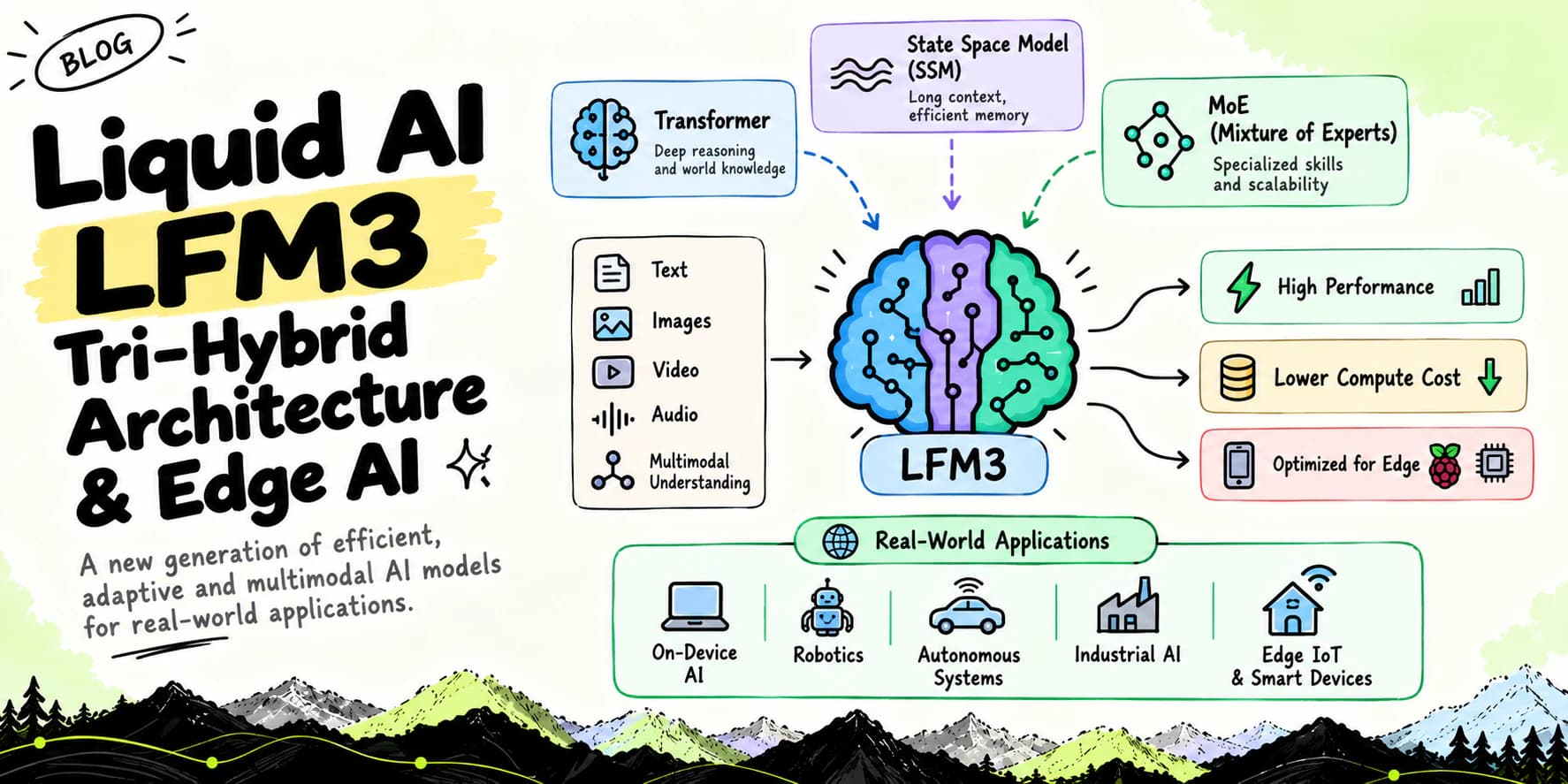
On October 27, 2026, Liquid AI introduced LFM3 (Liquid Foundation Models 3), an open-weight foundation model family built around a radically different architectural concept: the Tri-Hybrid Architecture.
Derived from a unified LFM3-1.7B-Base backbone trained on 22 trillion tokens, LFM3 mixes gated short convolutions, sliding-window attention (SWA), and global attention within a 24-layer design. The resulting 1.7B text model supports an expansive 256K-token context window, fits into approximately 1 GB of RAM at 4-bit quantization, and cuts KV cache memory consumption by over 70% compared to traditional Transformers.
This article breaks down the engineering mathematics behind LFM3: why the tri-hybrid architecture unlocks unprecedented edge efficiency, how its KV cache math works over 256K contexts, and how to evaluate and deploy LFM3 across heterogeneous edge hardware.
The Tri-Hybrid Architecture: Gated Convolutions, SWA, and Global Attention#
Standard Transformers treat all token distances identically: every token in layer $l$ attends to every token in layer $l-1$. However, linguistic information exhibits profound locality: over 80% of syntactic parsing and immediate contextual relationships occur within adjacent token clusters.
To exploit this physical reality, Liquid AI conducted a hardware-in-the-loop neural architecture search across 14 edge and cloud backends (including Qualcomm Hexagon NPUs, Apple Silicon M-series, AMD Ryzen AI, and ARM Cortex-A processors). The search converged on a 24-layer heterogeneous arrangement:
1. 13 Gated Short Convolution Layers ($k=7$)#
Rather than using heavy self-attention for every layer, LFM3 replaces over half the model (13 out of 24 layers) with gated 1D short convolutions.
- In LFM2, the kernel width was 3. In LFM3, the kernel width was widened to $k = 7$.
- Short convolutions have zero KV cache overhead. Their state size is strictly bounded by the kernel width ($O(k)$), which means memory usage does not increase as the context grows from 1K to 256K tokens.
- Hardware execution is exceptionally fast: modern SIMD and NPU vector units can process depthwise 1D convolutions with near-perfect memory locality.
2. 5 Sliding-Window Attention (SWA) Layers ($W=256$)#
For intermediate semantic context, LFM3 introduces 5 Sliding-Window Attention layers with a fixed localized window of 256 tokens.
- Tokens only compute attention over their immediate 256-token neighborhood: $$ ext{Attention}(Q_i, K_{j}, V_{j}) quad ext{where } i - 256 le j le i$$
- SWA bounds the cache size for these 5 layers to exactly 256 entries per head, completely neutralizing memory growth for mid-tier layers regardless of document length.
3. 6 Global Attention Layers#
To preserve the model's ability to perform complex long-range reasoning, cross-document summarization, and needle-in-a-haystack retrieval across 256K tokens, LFM3 places 6 full global attention layers strategically throughout the depth of the network.
- These 6 layers maintain global visibility across the entire sequence.
- Because only 6 of the 24 layers maintain a full KV cache, the total KV cache memory burden is slashed by approximately 75% relative to a traditional 24-layer Transformer.
Hardware Kernel Execution: 1D Depthwise Convolutions vs Attention FLOPS#
Why does replacing self-attention with short convolutions produce such a massive speedup on mobile and edge devices? The answer lies in the fundamental difference between memory bandwidth-bound operations and compute-bound operations.
In autoregressive token decoding, self-attention requires streaming the entire KV cache from off-chip DRAM into on-chip SRAM for every single token generated. For a sequence of length $N$, the arithmetic intensity is extremely low: $$ ext{Arithmetic Intensity}_{ ext{Attn}} = rac{mathcal{O}(N)}{mathcal{O}(N)} approx 1 ext{ FLOP/byte}$$
In contrast, a 1D short convolution with kernel size $k=7$ maintains a fixed internal FIFO buffer of 7 tokens per channel: $$ ext{State Size}{ ext{Conv}} = k imes d{ ext{channel}} = 7 imes d_{ ext{channel}}$$ Because this buffer fits entirely within the L1/L2 cache of an Apple M4 NEON core or Qualcomm Hexagon NPU tensor accelerator, the processor never accesses external DRAM to retrieve token history. The convolution executes at near-peak silicon FLOPS with zero memory bus saturation, consuming up to 65% less battery power per generated token.
Cache Line Locality and Vector Register Execution#
To understand why depthwise 1D convolutions run with zero memory thrashing, consider how modern ARM Cortex-A and Apple M-series processors manage their memory hierarchy. A 1D short convolution with kernel size $k=7$ maintains a sliding input buffer of exactly 7 tokens per channel.
When computing the depthwise product, the CPU loads the 7-token receptive field directly into 128-bit NEON vector registers via contiguous SIMD memory operations (vld1q_f32). In contrast to self-attention—where matrix multiplication coordinates must be recomputed and looked up dynamically across thousands of memory addresses—convolution weight matrices remain stationary in L1/L2 cache. This allows the processor's execution pipelines to maintain over 95% arithmetic saturation without stalling on RAM bus cycles.
Architectural Upgrades: Head-Wise Gating, Partial RoPE, and Sandwich Norm#
Scaling a hybrid model to 22 trillion pre-training tokens across multimodal domains requires structural innovations to guarantee numerical stability and quantization readiness. LFM3 implements three critical refinements:
1. Head-Wise Gated Attention#
One of the primary failure modes of sub-4B language models under INT4 or FP4 quantization is the emergence of activation outliers—isolated channels where hidden-state values spike to extreme magnitudes ($>100 imes$ the variance). When quantizing to 4-bit integers, these outliers destroy dynamic range, leading to catastrophic degradation.
LFM3 incorporates Head-Wise Gating: $$O_h = sigma(W_{gate} X) odot ext{Softmax}left( rac{Q_h K_h^T}{sqrt{d_k}} ight) V_h$$ A learned sigmoid gate dynamically scales the output of each individual attention head. This smoothly suppresses activation outliers before they propagate into downstream residual additions, allowing LFM3 to undergo aggressive 4-bit post-training quantization with virtually zero perplexity penalty.
2. Partial Rotary Position Embeddings (RoPE)#
In global attention layers, applying full rotary position coordinates to all head dimensions often causes high-frequency semantic blurring across ultra-long contexts. LFM3 applies RoPE strictly to the highest-frequency 50% of dimensions within each head vector, leaving the remaining 50% position-invariant. This preserves precise positional indexing for nearby tokens while maintaining invariant semantic representations for distant tokens.
3. Sandwich Normalization#
To stabilize gradients across deep hybrid transitions (switching between convolutional states and attention states), LFM3 places RMSNorm layers both before and after the mixer blocks (Sandwich Norm). This prevents gradient explosion during long-sequence backpropagation through time.
The 256K Context Window: KV Cache Memory Mathematics#
To understand why LFM3 represents a breakthrough for local AI engineering, let us compare the physical memory required to maintain a 128K and 256K context between a standard 2B Transformer and LFM3.
For a standard Grouped-Query Attention (GQA) Transformer: $$ ext{Memory}{ ext{KV}} = 2 imes L imes n{ ext{kv}} imes d_{ ext{head}} imes N imes ext{bytes_per_elem}$$ Where $L$ is layers, $n_{ ext{kv}}$ is KV heads, $d_{ ext{head}}$ is head dimension, and $N$ is sequence length.
| Sequence Length | Standard 2B Transformer (GQA, 24 Layers, FP16) | LFM3-1.7B Tri-Hybrid (FP16 KV) | LFM3-1.7B Tri-Hybrid (INT4 KV Cache) |
|---|---|---|---|
| 4,096 tokens (4K) | ~64 MB | ~18 MB | ~4.5 MB |
| 32,768 tokens (32K) | ~512 MB | ~140 MB | ~35 MB |
| 131,072 tokens (128K) | ~2,048 MB (2.05 GB) | ~560 MB | ~140 MB |
| 262,144 tokens (256K) | ~4,096 MB (4.10 GB) | ~1,120 MB (1.12 GB) | ~280 MB |
[!NOTE] On a standard edge device with 8 GB of unified memory (e.g., an Apple M4 Mac or a Samsung Galaxy S26 Ultra), a traditional Transformer processing a 256K context exhausts over 50% of the entire system RAM solely on the KV cache. LFM3 at INT4 processes the exact same 256K context in under 300 MB of RAM.
KV Cache Memory at 256K Tokens:
Standard 2B Transformer:  [==================================================] 4.10 GB
LFM3-1.7B (FP16):          [=============] 1.12 GB
LFM3-1.7B (INT4 Quant):    [===] 0.28 GB
The LFM3 Model Family Matrix#
Liquid AI released six specialized model checkpoints branching from the pre-trained LFM3-1.7B-Base:
| Model Name | Modality | Primary Focus | Quantized RAM Footprint | Key Differentiator |
|---|---|---|---|---|
| LFM3-1.7B | Text | General language, coding, 256K context | ~1.0 GB (INT4) | 128K vocabulary, 16 languages, beats LFM2.5-2.6B |
| LFM3-VL-2B | Vision + Text | Document OCR, UI understanding, video clips | ~1.3 GB (INT4) | Processes multi-frame video inputs at edge frame rates |
| LFM3-Audio-2B | Audio + Text | Speech-to-text, native voice synthesis | ~1.2 GB (INT4) | Low-latency streaming voice assistant interface |
| LFM3-Omni-2B | Omni (Text, Vision, Audio) | Real-time multi-modal interaction | ~1.5 GB (INT4) | First end-to-end compact omni model |
| d1-2B | Decision (Vision) | Non-generative structured calibration | ~1.2 GB (INT4) | Returns calibrated risk scores / classifications |
| d1-omni-2B | Decision (Omni) | Multimodal robotics & autonomous actions | ~1.4 GB (INT4) | Direct action-policy generation for robotics controllers |
Fine-Tuning LFM3: PEFT and LoRA Across Hybrid Layers#
Deploying LFM3 to proprietary domain tasks often requires parameter-efficient fine-tuning (PEFT). Because LFM3 alternates between convolutions and multi-head attention, developers must configure LoRA target modules thoughtfully.
To achieve maximum adaptation efficiency, apply low-rank matrices to attention projections while keeping short convolutions frozen or adapted via lightweight linear biases:
import torch
from peft import LoraConfig, get_peft_model
from transformers import AutoModelForCausalLM

model_id = "liquid-ai/LFM3-1.7B"
model = AutoModelForCausalLM.from_pretrained(
    model_id,
    torch_dtype=torch.bfloat16,
    trust_remote_code=True
)

# Target attention projections across the 6 global and 5 SWA layers
lora_config = LoraConfig(
    r=16,
    lora_alpha=32,
    target_modules=["q_proj", "v_proj", "out_proj", "gate_proj"],
    lora_dropout=0.05,
    bias="none",
    task_type="CAUSAL_LM"
)

peft_model = get_peft_model(model, lora_config)
peft_model.print_trainable_parameters()
# Trainable params: ~12.4M (only 0.72% of total parameters)
Practical Deployment & Local Evaluation Guide#
For AI engineers looking to deploy LFM3 locally, the primary benchmark is not vendor-reported MMLU scores—it is workload-specific validation on targeted tasks such as structured JSON extraction, local document summarization, and function calling.
Local Inference via Python & PyTorch / Transformers#
import torch
from transformers import AutoModelForCausalLM, AutoTokenizer

model_id = "liquid-ai/LFM3-1.7B"

tokenizer = AutoTokenizer.from_pretrained(model_id)
model = AutoModelForCausalLM.from_pretrained(
    model_id,
    torch_dtype=torch.bfloat16,
    device_map="auto",
    trust_remote_code=True
)

prompt = "Analyze the following edge sensor telemetry and return a structured JSON alert:"
inputs = tokenizer(prompt, return_tensors="pt").to("cuda" if torch.cuda.is_available() else "cpu")

with torch.inference_mode():
    outputs = model.generate(
        **inputs,
        max_new_tokens=256,
        temperature=0.2,
        do_sample=False
    )

print(tokenizer.decode(outputs[0], skip_special_tokens=True))
Grammar-Guided Structured Decoding for Edge Agents#
When deploying sub-2B models like LFM3 to mobile applications, structured JSON reliability is critical. In cloud endpoints, developers often rely on multi-billion parameter models to self-correct invalid commas or unclosed brackets. On edge devices, developers cannot afford token retries.
By pairing LFM3 with context-free grammar (CFG) engines such as GBNF or Outlines, the inference runtime restricts the logits at each decoding step to only allow tokens that satisfy the predefined JSON Schema:
# Enforcing strict JSON schema on edge runtime via GBNF grammar
grammar_spec = r"""
root   ::= "{" ws ""status":" ws string "," ws ""confidence":" ws number "}"
string ::= """ [a-zA-Z0-9_ ]* """
number ::= [0-9]+ ("." [0-9]+)?
ws     ::= [
]*
"""
This guarantees 100% syntactically valid JSON output on the very first pass, eliminating the latency and compute overhead of post-hoc correction passes on constrained hardware.
Evaluating Edge Workloads: The 4-Metric Scorecard#
When benchmarking LFM3 against models like Llama-3.2-3B or Qwen-2.5-1.5B, measure these four hardware metrics:
- Time to First Token (TTFT): Measures pre-fill compute efficiency over long prompt sequences.
- Tokens Per Second (TPS): Measures memory bandwidth saturation during autoregressive decoding.
- Peak Resident Memory (RSS): Track total RAM allocation across 1K, 32K, and 128K context boundaries using
psutil. - Schema Adherence Rate: Verify that the model adheres to strict JSON Schema output without falling into repetitive hallucination loops.
Conclusion: The Era of Specialized, Edge-Native Foundation Models#
The release of Liquid AI's LFM3 validates an architectural pivot that the AI industry has anticipated for years: the future of on-device AI cannot rely on brute-force attention Transformers alone.
By orchestrating gated short convolutions for cheap local syntactic grouping, sliding-window attention for regional context, and sparse global attention for macro-sequence retrieval, LFM3 achieves what was previously considered impossible: a 1.7B-parameter model with a 256K context window that fits into 1 GB of memory.
For AI systems engineers, LFM3 provides a production-viable foundation for building fast, private, battery-efficient assistants that run locally on laptops, phones, and robotics hardware without sacrificing the long-context capabilities that modern agentic applications demand.
References and Technical Resources#
-
Liquid AI Official Research Blog
LFM3: A New Era of Open-Weight Multimodal Intelligence.
Liquid AI LFM3 Announcement -
Liquid Foundation Models on Hugging Face
Model weights, tokenizers, and deployment artifacts for LFM3-1.7B, LFM3-VL, and LFM3-Omni.
Hugging Face Liquid AI Repository -
Hardware-Aware Neural Architecture Search for Edge Inference
Benchmarking Conv-Attention hybrids on Qualcomm Hexagon NPUs and Apple Silicon.
Liquid AI Systems Documentation -
FlashAttention and Sliding Window Attention Mechanics
Tri Dao et al., Optimizing memory bandwidth for localized attention windows.
FlashAttention Research