
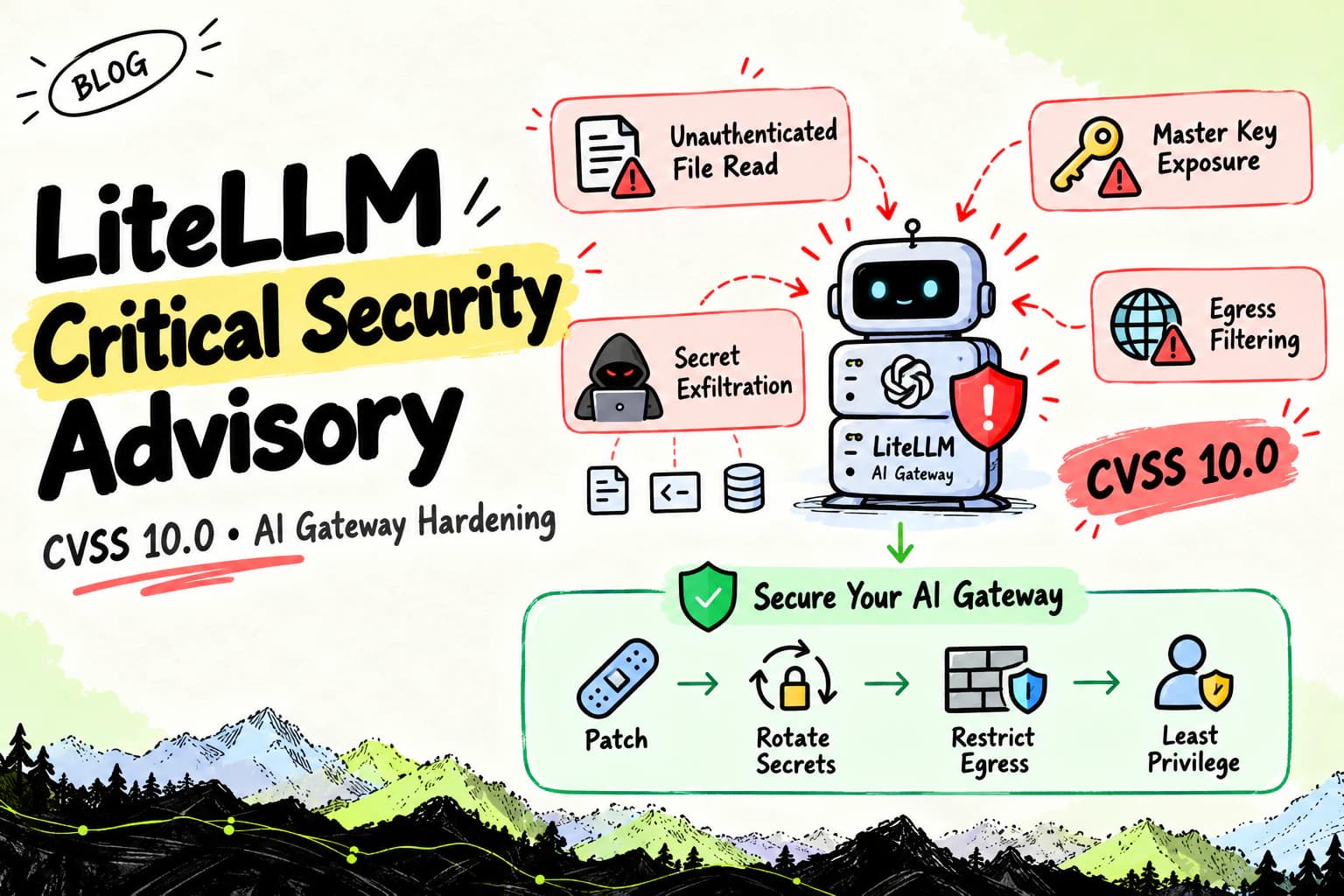
Introduction: The Vulnerability That Compromises the AI Control Plane#
In enterprise AI engineering, the LLM gateway is commonly treated as simple plumbing. It sits silently in the network architecture—routing user requests across OpenAI, Anthropic, AWS Bedrock, and self-hosted vLLM clusters, balancing token rate limits, tracking department spend budgets, and handling model failovers. Because gateways are designed to be high-throughput HTTP proxies, developers often fail to recognize that the AI gateway is the single most credential-dense component in modern AI infrastructure.
On October 27, 2026, the maintainers of LiteLLM published critical security advisory GHSA-w4c7-34wj-hqm8, carrying a maximum severity CVSS 10.0 score. The advisory documented an unauthenticated arbitrary file read and credential exfiltration vulnerability impacting Enterprise-licensed LiteLLM proxy deployments.
Under vulnerable conditions, an unauthenticated remote attacker could dispatch a crafted HTTP request to standard endpoints without passing any API key, cause the underlying proxy process to read arbitrary sensitive local files (including environment variables in /proc/self/environ), and transmit the resulting secrets directly to an attacker-controlled egress URL.
This vulnerability represents a catastrophic compromise of the AI control plane. This post provides a senior systems engineering analysis of GHSA-w4c7-34wj-hqm8: how the vulnerability operates, which deployments are exposed, an emergency secret rotation protocol, and how to build defense-in-depth network egress architectures that neutralize gateway exploits even in the event of zero-day vulnerabilities.
Anatomy of GHSA-w4c7-34wj-hqm8: Unauthenticated Arbitrary File Read#
To understand why this issue earned a CVSS 10.0 rating (CVSS:3.1/AV:N/AC:L/PR:N/UI:N/S:C/C:H/I:H/A:H), one must examine the specific mechanics of the flaw:
- Zero Authentication Required (
PR:N): An attacker requires no existing virtual proxy key, no team authentication token, and no administrative session. The vulnerability is triggered over unauthenticated ingress endpoints. - Local Arbitrary File Read (
C:H): The enterprise proxy implementation accepted unvalidated file path inputs within specific enterprise feature handlers. In Linux container environments, this permits directory traversal and direct reads of system virtual filesystems like/proc/self/environ,/proc/1/environ, and standard application configuration paths (/app/config.yaml). - Outbound Data Exfiltration: The flaw did not merely return file bytes in an HTTP error response; it could be instructed to push the read data outbound to an arbitrary attacker-specified URL.
- Scope Breach (
S:C): Accessing the gateway does not merely compromise the proxy process itself. Because the proxy holds downstream credentials for external model APIs and internal VPC databases, compromising the proxy breaches the boundary into all connected cloud services.
Scope Distinction: Enterprise vs Open Source#
The advisory specifically clarifies that open-source (OSS) LiteLLM deployments running without an Enterprise license are not vulnerable to this specific exploit path. The flaw resides within proprietary enterprise proxy modules governing enterprise user management, license validation, and custom routing policies.
However, teams should not assume safety based solely on licensing assumptions. Many teams test Enterprise features in staging or activate trial licenses without documenting them in centralized asset inventories. Every LiteLLM deployment must be actively audited.
Forensic Analysis: Reconstructing the Vulnerable Enterprise Middleware#
To understand how path traversal occurred within a high-performance Python ASGI application, we examine how enterprise policy modules handled dynamic filesystem references. In enterprise multi-tenant deployments, LiteLLM introduced capabilities allowing custom tenant policy rules and license sync caches to be loaded dynamically from localized paths.
Consider the vulnerable pattern observed in unpatched enterprise endpoints:
# Vulnerable conceptual pattern in unpatched enterprise handler
@router.post("/enterprise/tenant/policy/sync")
async def sync_tenant_policy(request: Request, payload: TenantSyncPayload):
    # Missing authentication check on enterprise tenant onboarding
    target_path = payload.policy_path  # User-controlled input

    # Path traversal: input like "/proc/self/environ" or "../../../etc/shadow"
    if os.path.exists(target_path):
        with open(target_path, "r") as f:
            file_data = f.read()

        # Outbound webhook exfiltration trigger
        if payload.callback_url:
            async with httpx.AsyncClient() as client:
                await client.post(payload.callback_url, json={"content": file_data})

    return {"status": "synced"}
When this handler executed inside a containerized Linux pod, passing /proc/self/environ allowed an attacker to inspect the memory-mapped environment block of process ID 1. Because standard container deployments pass secrets via environment variables, this exposed all runtime tokens in a single request.
Affected Versions and Immediate Patch Matrix#
The LiteLLM maintainers released emergency security patches across four active release branches. Operating teams must identify their exact release branch and upgrade immediately to the designated fixed version:
| Release Line | Vulnerable Versions | Patched Version | Upstream Status |
|---|---|---|---|
| 1.106.x | < 1.106.5 | 1.106.5 | Supported & Patched |
| 1.105.x | < 1.105.6 | 1.105.6 | Supported & Patched |
| 1.104.x | < 1.104.8 | 1.104.8 | Supported & Patched |
| 1.103.x | < 1.103.10 | 1.103.10 | Supported & Patched |
| Legacy (< 1.103) | All prior versions | Migrate to >= 1.106.5 | End of Life / Unsupported |
[!CRITICAL] Do not cross major release lines blindly without checking migration notes. If your production cluster is on
1.104.x, upgrade immediately to1.104.8rather than attempting an unvetted jump to1.106.5. Verify database schemas before promoting major versions.
The Secret Blast Radius: What Leaks When the Gateway Falls?#
Why is an arbitrary file read on an AI gateway vastly more destructive than on a standard web application? Consider the contents of a typical LiteLLM container's environment variables:
# What an attacker obtains by reading /proc/self/environ:
LITELLM_MASTER_KEY=sk-litellm-master-production-9023481029384019
DATABASE_URL=postgresql://postgres:p4ssw0rd@db.internal.corp:5432/litellm_db
OPENAI_API_KEY=sk-proj-abc123def456ghi789...
ANTHROPIC_API_KEY=sk-ant-api03-xyz987...
AWS_ACCESS_KEY_ID=AKIAIOSFODNN7EXAMPLE
AWS_SECRET_ACCESS_KEY=wJalrXUtnFEMI/K7MDENG/bPxRfiCYEXAMPLEKEY
AZURE_API_KEY=7c8d9e0f1a2b3c4d5e6f7a8b9c0d1e2f
VERTEX_AI_CREDENTIALS={"type": "service_account", "project_id": "corp-ai-prod", ...}
1. Root Administrative Control (LITELLM_MASTER_KEY)#
With the master key, an attacker has uninhibited access to the LiteLLM Admin API (/key/generate, /team/new, /spend/calculate). They can quietly provision persistent rogue API keys, alter rate limits, reroute prompt streams to third-party endpoints, or extract historical audit logs containing sensitive customer prompts and completions.
2. Downstream Cloud Provider Exhaustion & Exfiltration#
Downstream provider keys (OpenAI, Anthropic, Bedrock) allow direct model invocation bypassing all gateway logging and safeguards. Attackers utilize harvested keys to run distributed batch scraping, fine-tune proprietary competitor models, or rack up hundreds of thousands of dollars in automated inference debt within hours.
3. Deep VPC Pivot via Cloud IAM#
If AWS_ACCESS_KEY_ID or Google Cloud Service Account JSON keys are provisioned with excessive permissions (e.g., broad bedrock:* or full s3:* access), an attacker can pivot from the gateway into S3 buckets containing training data, model checkpoints, and confidential corporate embeddings.
Step-by-Step Incident Response & Secret Rotation Protocol#
If your organization operated a vulnerable LiteLLM Enterprise version exposed to network traffic prior to patching, you must treat your secrets as potentially compromised. Follow this 5-stage remediation runbook:
Stage 1: Immediate Ingress Isolation#
Before upgrading, sever public ingress to the proxy. Place the proxy behind authenticated Cloudflare Access, AWS ALB security groups restricting traffic strictly to trusted backend application IP addresses, or require internal VPN/mTLS. An AI gateway should never be directly exposed to the open internet.
Stage 2: Deploy Patched Binaries#
Update your Dockerfile or Helm chart values to pin the patched release tag:
# kubernetes/deployment.yaml
spec:
  containers:
  - name: litellm-proxy
    image: ghcr.io/berriai/litellm:main-v1.106.5
    imagePullPolicy: IfNotPresent
    securityContext:
      readOnlyRootFilesystem: true
      allowPrivilegeEscalation: false
      runAsNonRoot: true
      runAsUser: 10001
Stage 3: Forensic Telemetry & Log Inspection#
Check your ingress reverse proxy (Nginx, Traefik, Cloudflare) and gateway access logs for the following indicators of compromise (IoCs):
- Unauthenticated requests returning HTTP 200/500 with anomalous query parameters or request bodies containing file traversal sequences (
../,%2e%2e%2f,/proc/self). - Unusual outbound HTTP connections from the LiteLLM container pod to unrecognized external IP addresses or domains.
- Check AWS CloudTrail / GCP Audit Logs for API key usage originating from residential VPNs or foreign IP blocks.
Stage 4: Comprehensive Secret Rotation#
Rotate secrets in the following mandatory order:
- Master Gateway Key: Issue a new random 256-bit entropy token for
LITELLM_MASTER_KEY. - Database Password: Rotate the PostgreSQL password in
DATABASE_URLand revoke active sessions. - Downstream Provider API Keys: Log in to OpenAI, Anthropic, Google Cloud Console, and AWS IAM. Generate new replacement keys, update your secret store (HashiCorp Vault / AWS Secrets Manager), and revoke the previous keys.
- Virtual User Keys: If an attacker obtained the master key, inspect the
LiteLLM_VerificationTokentable in PostgreSQL for any rogue keys created during the vulnerability window, and invalidate them.
Defense-in-Depth: Egress Filtering Architecture for AI Gateways#
Why could the LiteLLM exploit transmit secrets to an external server in the first place? Because the vast majority of engineering teams configure their Kubernetes clusters with unrestricted outbound network egress.
When a pod has default egress access, any arbitrary code execution or SSRF exploit can immediately phone home to an attacker server. However, an AI gateway only ever needs to communicate with a tiny, well-defined set of upstream endpoints:
- Its internal PostgreSQL metadata store
- Its internal Redis caching cluster
- Explicit LLM provider APIs (
api.openai.com,api.anthropic.com,*.bedrock.us-east-1.amazonaws.com)
By enforcing strict egress filtering, even if a vulnerability allows an unauthenticated file read, the exfiltration step fails immediately because the container cannot open a TCP socket to an unauthorized external IP.
Implementing Cilium eBPF L7 Network Policy#
Here is a production-grade Cilium Network Policy that locks down an AI gateway to authorized DNS names and blocks all arbitrary egress:
apiVersion: "cilium.io/v2"
kind: CiliumNetworkPolicy
metadata:
  name: litellm-strict-egress
  namespace: ai-platform
spec:
  endpointSelector:
    matchLabels:
      app: litellm-proxy
  egress:
    # 1. Allow internal DNS resolution
    - toEndpoints:
        - matchLabels:
            k8s:io.kubernetes.pod.namespace: kube-system
            k8s-app: kube-dns
      toPorts:
        - ports:
            - port: "53"
              protocol: UDP
          rules:
            dns:
              - matchPattern: "*"
    # 2. Allow internal Postgres & Redis
    - toEndpoints:
        - matchLabels:
            app: postgres-litellm
      toPorts:
        - ports:
            - port: "5432"
              protocol: TCP
    - toEndpoints:
        - matchLabels:
            app: redis-cache
      toPorts:
        - ports:
            - port: "6379"
              protocol: TCP
    # 3. Whitelist explicit external model APIs only (L7 FQDN enforcement)
    - toFQDNs:
        - matchName: "api.openai.com"
        - matchName: "api.anthropic.com"
        - matchPattern: "*.amazonaws.com"
      toPorts:
        - ports:
            - port: "443"
              protocol: TCP
With this eBPF policy active in the Linux kernel, any attempt by the proxy process to connect to attacker-controlled.net is dropped at the socket layer before a single byte of sensitive key data leaves the node.
Vault Dynamic Secret Leases vs Static Environment Variables#
The most fundamental architectural flaw highlighted by GHSA-w4c7-34wj-hqm8 is the widespread practice of passing long-lived static API credentials as container environment variables. In modern cloud-native security, static environment variables should be replaced with dynamic secret leasing.
Using HashiCorp Vault or AWS Secrets Manager with AWS IAM Roles for Service Accounts (IRSA):
- Ephemeral Tokens: LiteLLM requests short-lived credentials with a 30-minute Time-To-Live (TTL).
- Memory-Only Ingestion: Secrets are injected directly via in-memory tmpfs filesystems (
/dev/shm/secrets) rather than environment strings visible in/proc/self/environ. - Automated Revocation: If an anomaly or unauthorized outbound request is detected, Vault instantly revokes the lease across the entire cluster without requiring manual operator intervention.
Gateway Hardening Checklist#
| Architectural Layer | Recommended Control | Security Benefit |
|---|---|---|
| Network Ingress | Terminate behind mTLS or private API gateway | Eliminates unauthenticated public internet exposure |
| Network Egress | Cilium / Envoy FQDN egress whitelisting | Blocks SSRF, exfiltration, and reverse shells |
| Filesystem | readOnlyRootFilesystem: true + tmpfs | Prevents writing dropped malicious scripts or payloads |
| Secret Storage | Vault dynamic secrets / AWS Secrets Manager | Avoids storing static API keys in plaintext /proc/self/environ |
| Container User | Non-root UID 10001, no privilege escalation | Mitigates local container breakout vectors |
| Audit Logging | Centralized streaming to OpenSearch / Datadog | Detects anomalous prompt volumes and rogue token generation |
Conclusion: Treat the AI Gateway as a Tier-0 Security Boundary#
The October 27 LiteLLM advisory GHSA-w4c7-34wj-hqm8 is an urgent wake-up call for AI platform teams. AI gateways are not passive middleware; they are high-value credential vaults that sit at the intersection of your internal infrastructure and third-party foundation model APIs.
Patching to versions 1.106.5, 1.105.6, 1.104.8, or 1.103.10 is the non-negotiable first step. But true enterprise resilience requires designing systems where a single software flaw cannot compromise the kingdom. By combining ephemeral, read-only container runtimes with strict eBPF network egress filtering and rapid secret rotation automation, engineering teams can insulate their AI infrastructure against both known advisories and future zero-days.
References and Official Advisories#
-
GitHub Security Advisory: GHSA-w4c7-34wj-hqm8
LiteLLM Enterprise Proxy Unauthenticated File Read Vulnerability (CVSS 10.0).
BerriAI LiteLLM Security Advisory -
LiteLLM Official Documentation & Release Notes
Fixed release tags and upgrade guidance for versions 1.106.5, 1.105.6, 1.104.8, 1.103.10.
LiteLLM Releases -
Cilium Network Policy Documentation
Securing Kubernetes egress with Layer 7 DNS and FQDN filtering rules.
Cilium L7 DNS Policies -
OWASP Top 10 for Large Language Model Applications
LLM07: System Information Leakage & Supply-Chain Vulnerabilities in AI Infrastructure.
OWASP LLM Security Project